
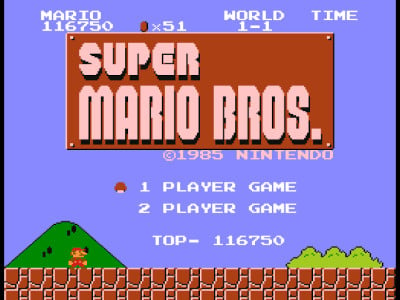
Super Mario Bros. (Nintendo Entertainment System) Review
The Platformer that Defined Platformers
~by tankMage (November 2026)
Score: 100/100 (Excellent)
Yep, it’s a Super Mario Bros. review…finally. Somehow, I managed to run a retro gaming site for nearly eleven years without reviewing one of the most important video games ever made. In my defense, I didn’t see much of a point in doing so, because Super Mario Bros. has been reviewed to death. To make this review itself a bit more interesting, I’ll talk more about my past experiences with it a bit more than I usually do when it comes to titles I’ve played.
One thing I have to own up to is the fact that I don’t always appreciate the games I play. Just read my Dragon Warrior review if you don’t believe me hehe. Well, it’s almost impossible for me to not appreciate SMB1, because platforming is my favorite genre. While there were certainly excellent platform games (like Pitfall) before it, Super Mario Bros. permanently changed what it meant to be a platformer.
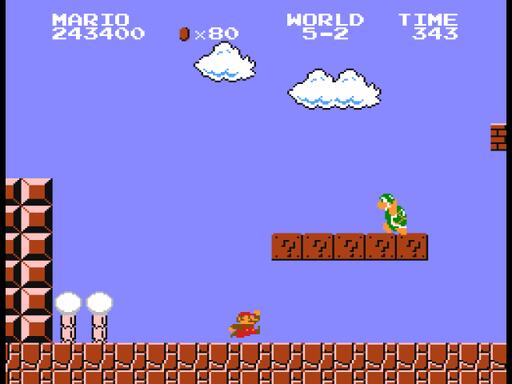
You probably already know this, but the object is fairly simple: run from the left side of the screen to the right without getting killed. If you make it, you’ll complete the stage by jumping on a flag, defeating one of Bowser’s minions, or by grabbing a golden ax…no not THAT Golden Axe! It’s a simple concept, but it’s the details that matter. Mario can find mushrooms that make him bigger and capable of breaking certain bricks as well as a flower that allows him to throw fireballs by hitting “?” boxes. You’ll need these powers because every stage is home to all sorts of bad guys and hazards that can end Mario’s adventure. Stages are designed brilliantly using the NES’s limited resources and adapting to the challenges the devs throw at the player is a big part of the joy of not only SMB1, but video games in general.
Mario (and Luigi, can’t forget him) has a lot of momentum and controls like an old muscle car, which is a part of the challenge. Stopping isn’t easy, so you’re going to slam into goombas or fall into holes until you get good at controlling the brothers Mario. Mastering how Mario moves is where the real magic comes into play because a truly experienced player can basically fly through stages using the pudgy plumber’s momentum.
My personal experiences with Super Mario Bros. are probably much like those of other gamers who were young children in the late 80s. It’s one of the first games I remember playing and the very first game I played on the NES. Even then it felt like SMB had always been around. It’s difficult for me to imagine a world without it, in fact I thought it was the first video game. Of course I found out about early computers, Atari, and arcades as I got older, but even after playing titles that predated it, I couldn’t help but feel everything started with that first Super Mario game. In a way I was right since Nintendo’s red and blue mascot resurrected the industry and introduced entire generations to gaming.
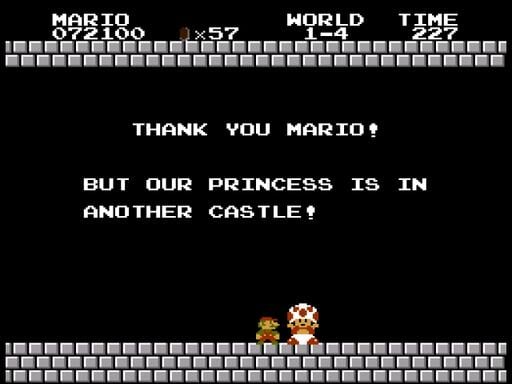
For me, this title was a training ground. I remember patting my five year old self on the back after stomping the first goomba and figuring out how to grab the mushroom only to get stuck trying to jump over the first pipe…eventually I figured it out. With that I was hooked. Super Mario Bros. introduced challenge after challenge to overcome and I gobbled it up. When I finally cleared the Stage 1-4 castle I thought I finished the game only to learn that there was more, much more.
It wasn’t long before I got new games and Super Mario Bros. ended up collecting dust on the shelf. It’s not that I didn’t enjoy it, instead it was more a matter of what came afterward being so much more intriguing. This was especially true for SMB2, which introduced the ability to pick up and throw enemies. For my young self it was just hard to go back to the more simple game when there was so much more out there.
At the same time, the fact that I hadn’t completed SMB nagged me for years. Like I said, there was just so much to play on the NES that the first Mario game kept getting pushed back on the list. And when I finally beat it at the age of twelve, I did it on Super Mario All Stars for the SNES. I didn’t complete the actual original version of this game until I was twenty. Back then, finishing it was just a box to check, though I did enjoy it. After finishing so many other Mario titles I didn’t think beating the first one meant all that much. Then I picked Super Mario Bros. up again a few days ago for the first time in a quarter century (good grief I’m getting old) and beat it for what may be the last time…until I replay Mario All Stars.
When I started this week it was quite a challenge since I haven’t touched a platformer in a few years. For the first time, I really appreciated the game that had been with me for my entire gaming career. Learning how to control the slippery plumber and practicing the stages was not only a trip down memory lane, but a reintroduction to a genre starting with its most iconic title.
So what makes SMB so great? Despite being extremely simple compared to what would come after it, even on the NES, it’s a beautifully designed game. Players are introduced to its core gameplay elements gradually. My experience defeating the first goomba, then having to figure out how to jump over pipes when I was a kid is a good example of how SMB teaches players how to overcome obstacles bit by bit. Later stages challenge players to put everything they learned together.
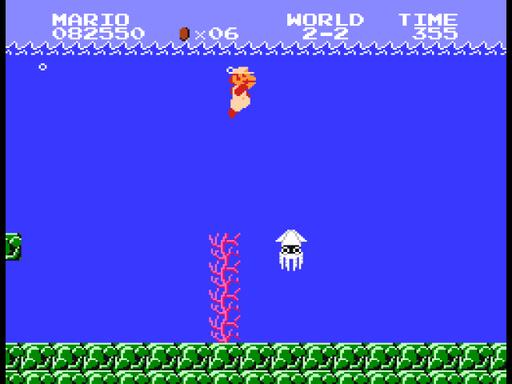
Difficulty progression isn’t perfect. There are a few spots where players have to navigate simple mazes or the area they are running through will loop until time runs out. While the idea is cool, there’s no real way for players to figure out what is required of them outside of trial and error. Nintendo must have known the maze system was an issue because they added a chime that indicates that the player has taken the right path in later iterations of the game.
The controls are great, despite being very floaty. While the decision to tighten up Mario’s handling in sequels was for the better, SMB1’s loose controls can be a lot of fun once you get used to them. For a long time the controls were my primary complaint about this game, but I finally get it years later after playing dozens of platformers. In fact, Mario makes Sonic look like a bit of a slow poke as he hurtles through stages.
Last, but not least, there is the music. Mario’s famous theme saw its first appearance here along with several other notable pieces. Every track is iconic and many reappear in later sequels. I’m pretty sure there are only about four songs in the game, which isn’t much even for NES, but SMB makes up for its lack of variety with quality.
Well, I don’t have much else to say about Super Mario Bros. It’s a near perfect platformer and the reason we have so many other great games. I know saying it’s near perfect, then giving it a perfect score doesn’t make sense, but I added points for innovation. Hey, it makes sense to me, ok?
If you like retro games and haven’t played SMB then what are you doing? Go play it now.
Thank you for reading my Super Mario Bros. review!
RetroMaggedon.com ©2026