
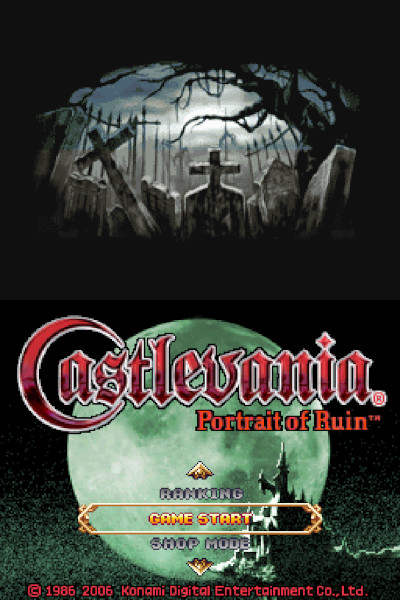
Castlevania: Portrait of Ruin (Nintendo DS) Review
Remember when Konami made great games?
~by tankMage (July 2026)
Score: 90/100 (Excellent)
I can think of three reasons to buy a Nintendo DS, all of which are what fans lovingly call “Igavania” games. OK, OK, there are a lot more great DS games than that, but Castlevania is what sold me on Nintendo’s handheld back in the 2000s. At any rate, Portrait of Ruin is essentially the middle child of the DS Castlevania trilogy. As such, it was kind of neglected by the devs. It has a rushed feel to it and a lot of its mechanics feel only partially realized. But, like any good middle child, it compensates by being really good at what it does.
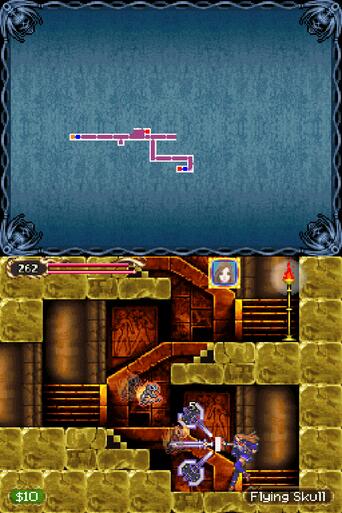
So, Castlevania: Portrait of Ruin (just gonna call it Portrait for the sake of brevity) is set during the second World War and acts as a sequel to Bloodlines for the Sega Genesis. Consequently, it’s a sequel to a spinoff that was made for one of Nintendo’s greatest competitors… a series can get weird if it runs long enough, what can I say? Being a spinoff, it focuses on two side characters rather than one of the Belmonts. In this case, the protagonists are Jonathan Morris, an accomplished young fighter, and Charlotte Whats-Her-Name, a powerful magic user. Drac’s Castle has re-materialized before its due date once again, so it’s up to the monster hunting duo to investigate. Come to think of it, Dracula’s Castle is supposed only only appear once every hundred years, but it seems to happen as frequently as Taco Tuesday at this point. Anyway, the heroes realize something is rotten in the state of Transylvania when they discover a mysterious mystical painting that is somehow sealing Drac off from his own castle. They soon learn a vampire artist (I’m not joking) named Brauner is behind the scheme, because he wants to take control of the castle himself. Apparently Brauner thinks he’d do a better job of tormenting humanity than good old Vlad; who knows, maybe he would?
I don’t want to spoil the plot, so I’ll just say Jonathan and Charlotte meet a few other characters, some of which are tied to Bloodlines. Overall, the story is alright. It’s a fresh way of looking at a series that was already two decades old by 2006 and it explores some loose ends. Of course, it’s also very predictable, so do not expect any shocking revelations. I feel like better dialog would have spiced the story up quite a bit. While Jonathan and Charlotte have a few amusing exchanges, the script reads like the competent, yet mechanical translations that were common at the time, which means it lacks dramatic flair. I guess we can either have boring, accurate translations or clumsy, entertaining ones.
Portrait’s story may not be top notch, but it acts as an important vehicle for something that really helps the game stand out: It gives the devs a means of freeing the series from the confines of the castle. For most of its existence, the Castlevania series has been bound to Castle Dracula, so by the time Portrait came out, there were at least ten games in the series where the player explores the same place. To be fair, Castlevania II & III had players traveling around Transylvania, plus many of the games featured areas around the castle, but Konami was still limited in terms of what settings they could use without destroying immersion.
Portrait was free to take players to all kinds of new places, because Jonathan and Charlotte had to enter Brauner’s paintings in order to wrest the castle from his control. The end result was a much needed breath of fresh air, however, it’s clear the devs weren’t able to do as much as they wished with the concept, because they had to recycle the first four locations for another set of paintings in the second half of the game. These novel areas include a spooky town, an Egyptian pyramid, a creepy circus, and a haunted school. While these areas were a nice change of pace, I felt like the only one that really stood out was the pyramid. I guess someone at Konami wanted Igarashi to play it safe.
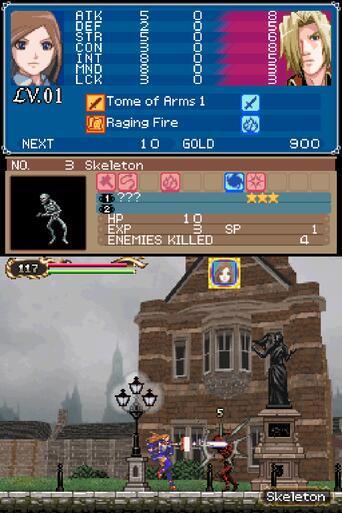
You can also tell the game feels rushed from the graphics. The first painting has a 3D background and a variety of beautiful details, like objects that fall from shelves when the player jumps on them, but the rest of the game looks very flat as though the finer details had been left out in hopes of filling them in later on. Sadly, that never happened, so Portait of Ruin isn’t as gorgeous as it could have been. Even though most areas lack the detail of the first one, they still look good and offer much needed variety to the series as I mentioned earlier.
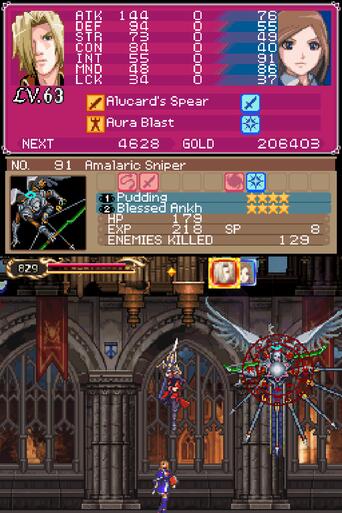
Despite being rushed, it’s one of the better looking DS titles. Charlotte and Jonathan are well animated, plus their character designs look nice even on the low resolution DS screen. There are also dozens of spells, huge bosses, and some pretty cool looking lesser monsters. Portrait also boasts a huge arsenal of weapons, many of which have their own unique designs.
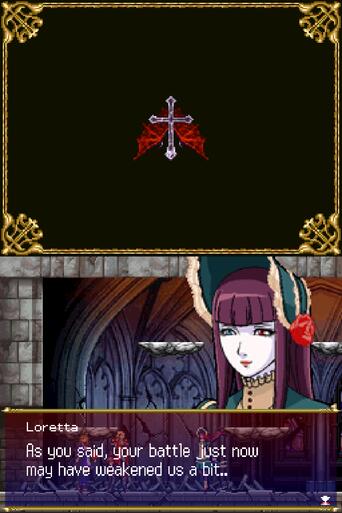
One thing I didn’t really like about the graphics is the generic anime style of the character portraits. All of the characters look like they are from some third rate late 2000s anime, which is a downgrade from beautifully drawn characters in Symphony of the Night. In fact, I’d go as far to say the art style is a step down from Dawn of Sorrow, which at least had more detail and personality. I’m not sure if this was a stylistic decision or if they rushed out the character designs, but I’m going to go with the former, because the heroes are front and center on the box art, plus there’s a fairly long cutscene that features them heavily. Character portraits and a single cutscene aren’t a big deal, so it’s not like it ruins the game, it’s just my self-appointed job to complain about minutiae.
The gameplay loop itself is fun, just as one would expect from Metroidvania. The heroes level up as they slay monsters, find new equipment, and solve exploration based puzzles. Konami was pretty strapped for ideas by now, so a lot of the powers the duo get are just reskins of old staples like Alucard’s bat form, but there are a few novel ideas like the ability to turn into a toad to get through small spaces..oh wait, that’s not much different from some of the other powers in previous entries to the series. Like its predecessors, Portrait leans heavily into farming items and weapons from monsters, which can be tedious, though this feature of the game can be skipped.
Konami also added a simple quest system to shake things up a bit. To be honest, the quests are mostly mediocre “go find and kill this monster” or “activate this device” deals that award players with weapons, spells, and the occasional HP/MP upgrade. They’re fine, but they don’t add much aside from another set of boxes to check off. It would have been nice if they awarded players with an item that would force an enemy to drop its loot when used. Hey, I know that’s asking a lot, but it would have been good.
Portrait isn’t difficult. I tried going through the game at a low level to make it more challenging, but most of the monsters and bosses were still pushovers. In fact, character levels don’t mean much compared to equipment and a good stock of healing items. That’s not to say Portrait of Ruin lacks decent boss fights, because there are a couple of tricky ones. However, the game is very easy for the most part.
Speaking of bosses, there were a few of them that required the player (or at least strongly urged them) to use the character switching mechanic and the two hero’s abilities creatively. One example is a boss that could take control of one of the heroes, which forces the player to either use a certain character or switch before the boss launched its charm attack. Sadly, these bosses were a exceptions rather than the rule. It would have been nice to see the devs get a bit more creative with the system, since there was tremendous potential in it. Once again, this is an indicator that Portrait was developed under tight constraints.
For all its faults, Portrait succeeded in righting a grievous wrong that hurt its predecessor on the DS, Dawn of Sorrow. See, Dawn of Sorrow has some of those good old forced touchscreen mechanics baked into it, like so many other DS games…thanks Nintendo. In this case, players had to draw a magic seal on the touchscreen to fully destroy bosses. The idea wasn’t bad in itself, execution was the issue, because the seals could get difficult to draw and it was annoying to have to try and hold the stylus while fighting a boss AND draw an intricate symbol under a time limit. Konami must have realized the mechanic was unpopular and told Nintendo to shove it, because it’s not in this game…OK, I doubt Konami told Nintendo to shove their touchscreen mechanics, but let a guy dream.
At any rate, the touchscreen controls are largely used for navigating menus. You may also be able to guide certain abilities with it, but I could be thinking of another game. I’ll be honest, I touch the stylus as little as possible after reviewing roughly twenty DS games. Regardless, Portrait of Ruin feels really good to play from a user interface perspective. All of the controls work great and the game is set up to be very user friendly, especially for a handheld from 2006.
We’re getting close to the end of this review, so it’s time to talk about the music. While playing, I realized the BGM sounded a lot like Bloodstained: Ritual of the Night. Wouldn’t you know, the same composer worked on both games. In fact, two heavy hitting video game music composers (Michiru Yamane and Yuzo Koshiro) worked on this sound track and it really shows, because Portrait has some awesome music. I can’t think of a track I didn’t enjoy and I’m picky when it comes to music.
There’s also some light voice acting, which is the kind of voice acting I love. This is likely a pet peeve of mine, but I’d rather just read dialog than listen to some NPC drone on about some fetch quest. That said, Jonathan and Charlotte still have a lot of lines, but they’re more for flavor than anything else.
And the verdict is……*drum roll*
Castlevania: Portrait of Ruin is a somewhat troubled game. Anyone whose played a lot of video games can see where the devs had to cut corners. At the same time, it’s a really fun ARPG that kept me engaged even though I played it thoroughly years ago. The ability to switch heroes adds a lot of texture to the action, plus there’s a lot to see and do. It also adheres to the tried and true Igavania formula, so players know exactly what they are getting if they played any his other works. Better yet, Portrait is devoid of annoying touchscreen tomfoolery, which is something I really appreciate.
I will admit that the score I gave this game may be a bit inflated. In my defense, anything that isn’t shovelware gets extra credit on handhelds. It’s also commendable that the dev team tried to innovate, even if they didn’t get to do as much as they wanted to with the new mechanics.
If you’re on the fence about playing this title, I strongly suggest giving it a try, especially if you like other games in the genre. It’s not the best Metroidvania, yet it’s able to stand on its merits.
Thank you for reading my Castlevania: Portrait of Ruin review!
RetroMaggedon.com ©2026