
Castlevania: Lament of Innocence (PlayStation 2) Review
Castlevania: Lament of Hallways
~by tankMage (December 2025)
Score: 83/100 (Good)
Being a prequel, Lament of Innocence tells a tale many fans of the series are likely eager to hear. With Koji Igarashi, who has headed up a slew of Castlevnia titles, acting as director this title should have been a home run. Yet somehow, Iga and his team thought it was a good idea to pad the play time of Lament by adding dozens of long, pointless hallways to the level design. Leon Belmont spends more time running through corridors than he does fighting and it makes what could have been a frenetic, action packed adventure feel sluggish and dull.
Even with its poorly designed environments, Lament still has a lot to offer fans. Most importantly, it’s a rare (if not sole) example of an Igavania that does not feature an experience system, which makes it feel like a bridge between the older Castlevania titles and more modern incarnations of the series. Combat is also a highlight thanks to Leon’s whipping prowess, an arsenal of heart weapons, and some interesting enemies. And while the manner in which the story tries way too hard not to go in obvious directions leads to some rather silly narrative gynastics, it’s entertaining enough to keep players engaged with it. Finally, the soundtrack is one of the best I’ve heard on the PlayStation 2, so it’s kind of worth playing just for the music…though it’s easy enough to find the OST online come to think of it.
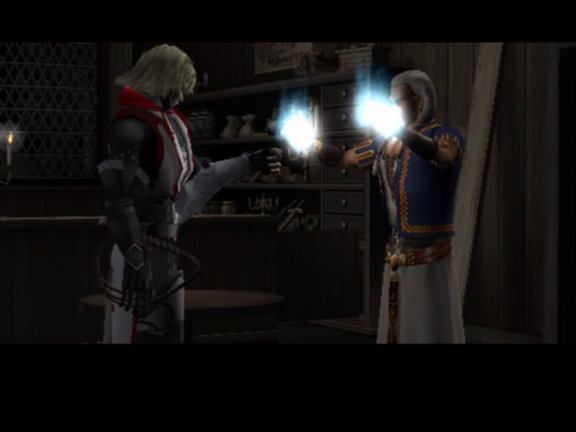
The Belmonts get the Igarashi treatment.
One thing I appreciated about the Castlevania series is that the mainline games were generally light on narrative, with a few exceptions of course. Yeah, yeah, I know people enjoy a good yarn, but how much can you feasibly squeeze out of some guy whipping Dracula in the face? For the most part the Belmonts are focused on kicking undead butt and don’t waste time doing things like thinking or talking. Symphony of the Night, which Iga was involved in, brought a fair bit of story telling to the series, but it didn’t feel out of place being a spin-off of about everyone’s favorite sulky Dhampir.
At any rate, Iga brought his dramatized approach to the series with Lament, which achieved mixed results. On one hand, the prequel story brings some interesting ideas to the table and expands on the world a bit. Learning how the Vampire Killer was created was fairly satisfying among other things.
On the other hand, the dialogue and story are a bit too campy, even for a video game. At one point Leon says “I will kill you and the night!” to one of the bad guys, which is one of the goofiest lines I’ve ever heard. At first I thought the devs were having a lark, but I’m fairly certain this was supposed to be an epic moment for Leon.
Flaws aside, the extra narrative and meme worthy dialogue don’t hurt the game much. That said, I can’t say the plot of Lament is a win for Iga. I gotta cut Koji a break here, because writing a story with a predetermined ending which everyone is familiar with is not an enviable task, so it’s fair to say he did the best he could with what he had to work with.
Graphics worthy of a 3D debut…oh wait, there’s that other 3D Castlevania game….
Despite having a few problems, Lament of Innocence looks great. The environments are detailed and varied, there are some impressive lighting effects (well impressive by PS2 standards) and Leon has a slew of cool looking powers. A few of the scenes in this game are breathtaking and I’m not talking about the succubus…though she isn’t half bad.
While the graphics are pretty good, a lot of the human characters have a bad case of uncanny valley syndrome. By that I mean they look really good considering the PS2’s limitations, especially compared to other games on the console, but they don’t seem natural and look like creepy dolls. Some characters suffer from this problem far more than others, but it’s an issue for all of them. One of the bosses, and I’m not talking about the doppelganger, looks too much like Leon, so I’m fairly sure they recycled his face, which is kind of lame.
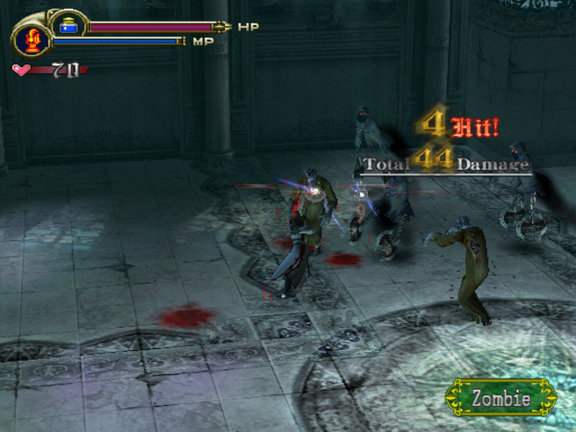
Stop interrupting my endless hallways with combat!
As I said earlier, Iga and his team would have done better to make the design of the castle a bit tighter even if doing so resulted in Lament being a very short game. Nearly every room is separated from adjacent rooms by a hallway. Some corridors have monsters, but they are just as likely to be empty. Consequently, you’re gonna spend a lot of time running around the castle and not in a fun way where the action flows. And trust me, there’s backtracking, which makes the presence of the endless hallways even more abrasive.
On the bright side, the actual combat is fairly good. Leon learns a lot of moves and fighting the denizens of the castle can be fun. There’s also a fair bit of exploration and puzzles to solve, though the puzzle solving aspect of the game is more of an afterthought. Leon will fight a few bosses over the course of the adventure. Some of them are fairly interesting with gimmicks the player has to figure out, but none of them are challenging as long as you have a few potions on hand. Come to think of it, there is a challenging boss that can be unlocked towards the end of the game. Unfortunately, the battle is fought in phases the first two of which are kind of tedious.
My favorite aspect of the game design is the orb system. Veteran Castlevania fans will remember the orbs that appear when Simon beats a boss in the first game. These orbs make an appearance in this title, but they do more than simply refill Leon’s health. Equipping an orb will change the way the heart weapons function. For example, the cross turns into lightning when the white orb is active. Overall, experimenting with the orbs was fun and they made heart weapons feel extra powerful in Lament.
At the end of the day, Lament could have really benefited from a more conservative level design philosophy. Less space between the rooms would have made the action flow a lot better. Usually long hallways are saved for dramatic suspense type areas and that’s where they belong. Of course that would have cut down on the total play time of Lament, which is why I suspect the devs have players trudging around in empty corridors in the first place. To be fair, it’s also possible Iga and his team were uncertain how to approach a 3D title. Maybe they merely used the same techniques that worked for other titles and hoped the end result would turn out well.
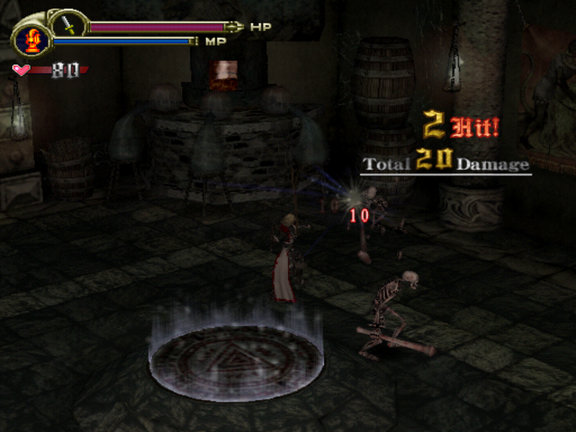
A killer soundtrack or should I say Vampire Killer!?
For a PlayStation 2 game, the soundtrack is amazing. There’s easily three or four memorable songs, like the theme for the House of Sacred remains and that of the final area. Even the lesser tracks are good. Fans of Symphony of the Night will likely recognize the excellent work of Michiru Yamane who also did the Bloodstained Ritual of the Night soundtrack.
Lament’s voice acting is competent and even surpasses the standards of it’s time to some degree. Being a more modern game, Leon tends to shout a lot as he fights, which has the potential to be annoying, but they did a god job of not going overboard with the voice effects. Nothing really stands out about the performances, however.
Miserable Menus
Lament’s user interface is nice when it comes to fighting, running around, and even platforming, which is not always the case when it comes to PS2 games. However, Konami decided to implement a garbage menu system called the “Active Menu”, though a more appropriate name would be “Atrocious Menu”. Pressing the Right Stick or hitting L3 brings up a window where the player can select usable items, equipment, and magical relics. On paper this seems OK, but in practice it’s trash. Want to use a potion? Well you’re gonna have to do it while a monster is smacking Leon around. Same goes for equipping stuff.
The game won’t even let the player change gear or use items in the main status screen that comes up when it is paused. It’s likely Iga and friends thought Lament would be too easy if you could pop potions with the game paused. Fair enough, Symphony of the Night required players to equip healing items to use them, but doing so at least happened on a normal inventory screen, so why they didn’t go with what worked is baffling.
Why they didn’t allow players to hotkey potions and other thing to the Right Stick or D-Pad is also beyond me. What’s worse, Lament allows players to select orbs and relics via radial menus mapped to the Left Bumper and Trigger buttons, which really begs the question why didn’t they just do that with other things? As we have it, the UI is a Frankenstien’s Monster whose existence is something of a riddle. Ultimately, it’s just bad regardless of why it was designed in such a way.
Nostalgia Time!
Lament and I go way back. I remember being excited for it when it was announced. I expected Symphony of the Night, but with a Belmont instead of Alucard. Then I found out it was 3D and passed. Something told me it wouldn’t be good. Years later I bought it cheap after the PS3 came out and gave it a try. It was OK as far as I was concerned, but I had a ton of games to play, so it ended up on the back burner until I finally picked it up now. Uh… this story was kind of pointless come to think of it, but I guess it illustrates my feelings towards Lament well enough: It’s a good game, but it’s outclassed by a slew of PS2 titles.
Final Thoughts
As I said in the rambling paragraph above, I’m glad I played Lament after waiting so long, but it’s nothing to write home about. It’s arguably the worst of the Igavania games, though that dubious award may go to the one with Juste Belmont, but it’s certainly not a bad game by any means. In the end, this title is more for hardcore Castlevania fans who want to experience everything the franchise has to offer. It’s certainly not a game I would show off if I were trying to convince a friend to try the series.
Thanks for reading my Castlevania: Lament of Innocence review!