
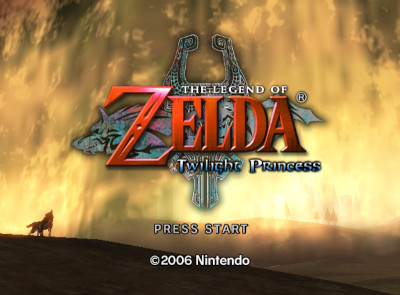
The Legend of Zelda: Twilight Princess Review (GameCube)
So brilliant its flaws don’t matter!
~by tankMage (August)
Score: 100/100 (Excellent)
The Legend of Zelda was already a venerable series by the time Twilight Princess was released in 2006, so expectations were high. Back then, I had long ago migrated from Nintendo products to Sony and PCs, but screenshots of this game caught my eye. It looked darker, more mature, and slightly alien for lack of a better term. While I intended to get the Wii version of Twilight Princess (Monster Hunter Tri had been announced for the Wii, so I was definitely getting one) I did not actually get around to playing it until now and went with the GameCube version instead… I love sixth gen systems, what can I say. You may be thinking I missed out, but I’m glad I waited, because I probably wouldn’t have appreciated Twilight Princess back when it was released.
Like any Zelda title, this one has Link gallivanting across Hyrule, exploring dungeons, cutting grass, and yelling “ha!” However, there’s a twist: Link catches a nasty case of lycanthropy early in his quest. I still don’t quite understand why he turns into a wolf, but it seems to be *ahem* linked to the power of twilight, which is corrupting the realm. See, an evil wizard named Zant is using the power of twilight to conquer Hyrule and is systematically locking each province down. What is twilight you ask? It’s spooky dark magic.
Link, a humble villager, and a girl named Ilia who serves as his love interest get captured when Zant’s forces invade to their neck of the woods. Link soon finds himself transformed into a wolf by the twilight and dragged off to prison. Luckily, a cheeky little creature named Midna helps him escape and accompanies him throughout the game. I don’t like to spoil stories and I won’t start now, so I’ll just say that the plot was clever enough to keep me engaged with it even though I could guess at what was going on. It even surprised me a few times.
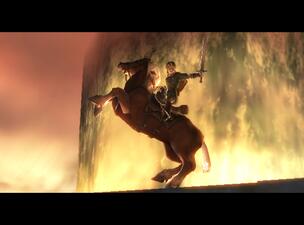
Twilight Princess’s eclectic and often eccentric cast carry the story. Every region has its own set of endearing characters that Link meets on his adventure. Nintendo were even clever enough to make some of them mildly unlikable, just to add some spice to the stew. Of course, Link is still a silent protagonist, which is fine by me, because I don’t want to hear him go on long monologues about the nature of heroism or see him weep over his tribulations.
The formula of the actual gameplay is pretty standard for the series. Link finds one of the regions in shambles or completely consumed by the Twilight and he must set things right. For the first three regions and their respective dungeons, this means exploring the twilight version of said region in Link’s wolf form and collecting drops of light to restore its guardian spirit, then jumping through a few more hoops to get into the dungeon. The last half is a little more straightforward, with Link merely having to do some investigating to enter most dungeons.
Before I talk about the dungeons, I should probably discuss Link’s wolf form. Link turns into a wolf while in the Twilight, kind of like how he turned into a rabbit in Link to the Past’s Dark World, except this time he isn’t helpless. Wolf Link has his own set of powerful attacks and can run rapidly. He can also see hidden treasures, spirits, and other things using his lupine senses. Midna even helps him out a bit with her magic to allow him to manipulate certain objects and jump long distances. Link his pretty much stuck in wolf form once he enters the Twilight, but he gains the ability to transform at will later on.
Wolf form adds a lot of variety to the gameplay and gave the devs some clever mechanics to play with. That said, it’s not as revolutionary as it was made out to be back when the game came out. It’s just a cool thing that adds a bit of extra punch to the action.
Getting back to the dungeons, I have to say these are the best dungeons I’ve seen in a Legend of Zelda game. Just keep in mind, I lost track of the series after Ocarina of Time, so there’s probably a lot I missed.
Most dungeons have a sort of central theme and act as a large puzzle built around a series of smaller ones. My description might not make much sense, so I’ll give an example. In the first dungeon, Link encounters a group of monkeys who have been imprisoned within it. As he frees the monkeys, they help him clear some of the dungeon’s obstacles and ultimately team up to help him reach the boss. This design makes the dungeons feel far more cohesive than they were in the past. It also makes them more memorable by adding story elements to them.
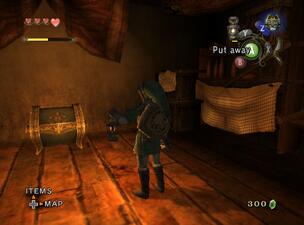
The dungeons and the items found in them are the true stars of this game. Forget the story, forget wolf form, it’s the dungeons that drive it forward. In fact, I was often eager to get to them just to see what they had in store. I’m not sure if Twilight Princess has the best LoZ dungeons, but it has to be a close contender for the number one spot.
Twilight Princess is also full of side quests. Fans of the series will recognize things like Pieces of Heart along with various mini-games. However, Nintendo added a few extra prop hunts to this title. Link can collect bugs to give to an insect enthusiast as well as Poe Souls to free some guy from a Midas-esque curse. In addition to all that, he can learn songs in wolf form. These songs summon an ancient warrior who will teach Link new sword techniques.
Speaking of Link’s sword, he has a whole host of cool moves. I’ll be honest, I was kind of disappointed to learn he couldn’t shoot sword beams anymore, but it’s cool, because the sword techniques make up for it. I suppose they thought sword beams would be over powered in a 3D title, but I’m not so sure since he has moves that can one-shot most monsters in this game. Either way, they did an excellent job of giving players a fun moveset to work with.
Oh, I almost forgot the bosses, which are amazing spectacles. Almost all of the boss battles feel huge and I mean that in both the stylistic sense and in terms of scale. In fact, one of my favorite boss battles of all time, which I’ll talk about in the spoilers section, is in this game.
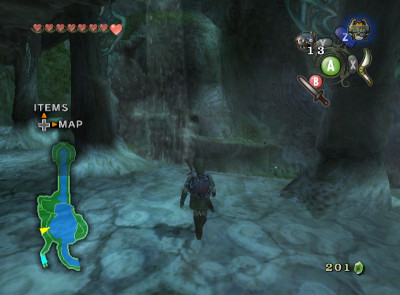
Twilight Princess also features some superb graphics being one of the later GameCube titles, though said graphics often tax the system. The art direction produced characters and environments that are surreal in a cartoonish sort of way. While this may not look good on paper, the end result is an experience that will stick in your imagination like a great movie. Nintendo did a beautiful job at conveying the personality of each NPC and Link through their character design. In fact, they did such a good job, you can pretty much guess how a character is going to act based on how they look.
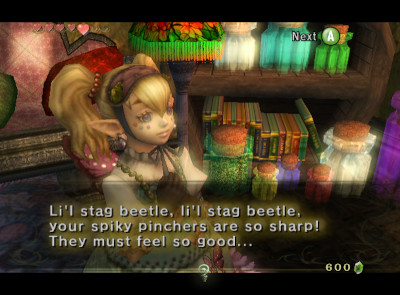
The environments are magnificent, especially when you take a moment to remember the GameCube is a sixth generation console. The fields of Hyrule feel vast and open. Dungeons are imposing, exotic worlds unto themselves. And there are cinematic moments that truly capture the spirit of the series, such as Link riding Epona across a bridge with the blazing sun as a backdrop.
Even Twilight Princess’s weakest aspect, it’s sound track, has a lot to offer. While the BGM is not quite the collection of anthemic songs that helped make Zelda great, it’s still excellent. The haunting and often bizarre tracks set the tone perfectly for this dark entry in the LoZ franchise. However, I felt that the use of a combat theme that plays whenever an enemy drew near Link threw the game’s vibes off a bit. The combat music often interrupted dungeon themes and made everything feel slightly less cohesive. For some reason, they turned off the battle theme in the final dungeon, which only served to emphasize how disruptive it was. It’s not a big deal, but I can’t help but think the game would have benefited if they just let the regular music play during combat.
I also have to applaud the sound effects. Twilight Princess is full of creative new jingles and even classic ones that give a bit of extra juice to the action. Characters also babble when talked to, which was a rather quirky trademark of Nintendo at the time. Honestly, I prefer the nonsensical babbling to full blown voice acting, because it adds a sense of mystery to the game world while still giving us insight into the speaker’s personality.
Time for some unpopular opinions!
As much as I love this game (I gave it a perfect score after all) there are some things I didn’t like about it. Before I start nitpicking, I have to say I didn’t deduct points from the score, because Twilight Princess’s strengths far outweigh any of its failings. It’s kind of like the game got a few questions wrong on a test, only to nail the extra credit and get 100% anyway.
For starters, there’s a lot of filler. And I mean a lot of filler. Finding dungeons isn’t as simple as blowing up a wall or pushing a rock anymore. Link is often given an checklist of chores to do before he can even think of tackling any of the dungeons. In all fairness, this is nothing new for the series, but it feels really pronounced in this game. I often got bored while running around, collecting whatsits for Joe Shmo or whoever just so I could enter the next dungeon.
I’d be lying if I said the filler parts are bad because they aren’t, it’s just that there’s too much of it. On top of that, I didn’t really get the sense of wonder that comes with being plopped in a big world to explore, because Link is railroaded into completing the dungeons in a specific order, which is also a little disappointing.
Additionally, there is bit too much stuff to collect. They increased the number of Heart Pieces Link needs to find to get an extra Heart Container from 4 to 5. This may not sound all that bad, but it means spending hours scouring the overworld and dungeons to get an extra Heart. It’s pretty clear this was done to make the game longer. The same goes for the wallet. The idea of Link needing bigger wallets kind of makes sense, but it also feels like it’s just there so they can say the game has a 50 hour play time.
Twilight Princess is also waaay too easy. It can be hard to solve puzzles sometimes due to the game’s 3D design, but aside from that, it’s generally not difficult to figure what to do. Combat is pathetically easy as well. The only time I died in this game is when I discovered Link can’t breathe underwater, which was admittedly really stupid on my part. It’s unfortunate, because I feel like slightly tougher combat would have helped a lot. Boss damage could have been doubled or even tripled in some cases to make them more exciting. Same goes for all the other monsters.
Spoiler Time
Don’t read this if you do not want certain aspects of Twilight Princess spoiled for you. Seriously, look away if you haven’t played the game yet.
.
.
.
.
Ok, I warned you, so here is the spoiler part of this review. So I really loved the boss and dungeon design of this game. I’ll pretend it’s 2006 and say most of the dungeons along with their bosses were epic. Maybe we can even pretend it’s 1990 and say they were “Totally rad, dude!” The first boss battle against a giant plant monster thing set the bar by including the chief of the monkeys I mentioned earlier. The boss is a huge monster Link can’t hope to reach, so the Monkey Chief helps him by swinging across the room with bombs. You have to grab the bombs with the boomerang and feed them to the boss. The entire fight is a brilliant capstone for the first dungeon.
Another boss fight is one of my favorite of all time. Later in the game, Link gets the Spinner, which is kind of like a skateboard that rides on rails found in some places. Link has to fight one of the bosses using the Spinner by gliding around the room and slamming into the boss. This alone is cool, but they kicked things up a notch in the second half of the battle where Link has to ride the Spinner up a huge pillar while slamming into a flying version of the boss and avoiding its fireballs.
In fact, the Spinner was one of the coolest items I’ve seen in any game. Sadly, it doesn’t get a ton of use and I wish they capitalized on it more instead of adding a dumb boating mini-game. Hey, maybe you like the boating mini-game, but a giant Spinner obstacle course would have been ten times better and you know it.
One thing that strikes me as odd is how the story doesn’t have a lot to do with the TriForce, Zelda, or even Ganon. They’re all there, yet they feel like afterthoughts. I’ve begun to suspect that Nintenduh developed the habit of taking ideas that were pitched for new, completely original games and modifying them into the Legend of Zelda mythos, because they aren’t willing to risk something new failing. I kind of get that feeling with Twilight Princess, though I could be wrong. After all, Nintenduh doesn’t invite me to board meetings…I can’t imagine why.
Even if it was repurposed, the story is really cool and I’m actually glad they went with it. Twilight Princess brought back the horror elements that were woven into the earlier games and doubled down on them. If you played the first game, Zelda II, or even Link’s Awakening and thought about them a bit, you may have picked up on their dark themes. Well, all that’s back in this one and it’s the only LoZ game that received a 13+ ESRB rating (or whatever it is) for things like blood, though the blood is extremely minimal. Telma’s cleavage may have also contributed to the 13+ rating come to think of it…
Zant, a wierd bird-snake-thing is the main baddy for most of the tale. To be honest, I have to admit that Nintendo managed to trick me into thinking he was just our old buddy Ganondorf in disguise, so I was a bit surprised to find that Zant was in cahoots with Gannon rather than being one of his alter-egos.
Speaking of Ganondork, I’m not really a fan of his modern designs and prefer his boar form. Admittedly, they nodded to his boar form during the final battle, where he actually turns into a giant boar. However, he was much more interesting when he was a mystery. I can’t hold the demystification of Ganon against Twilight Princess’s creators, because that cat has been out of the bag since Ocarina of Time. If anything, they could have used this game to completely reinvent Ganon, since this title appears to be a new branch on the tangled mess of the LoZ split timeline or whatever they call it. If I were a betting man, I’d put good money down on Nintendo not having a grand design for this series and merely winging it, but that’s out of the scope of this review.
Midna was a great character and a stroke of genius on the writer’s part. She remains a mystery for much of the game, but comes off as bossy and kind of untrustworthy. As the story progresses, she develops into a familiar friend, but still seems dodgy. It’s only towards the end that we learn where Midna really stands and what happened to her. By the end of the game she is one of the most endearing characters I’ve encountered in this series or any for that matter and it was sad to see her leave Hyrule for her home world. I’m not the mushy type, so congratulations to the writer for tugging at the old heart strings.
Final Thoughts
What more can I say? The Legend of Zelda: Twilight Princess is a great game. It has some…foibles…but it’s still an amazing title, which makes it even more impressive. It’s one thing for a game to do everything right and be worthy of a perfect score, it’s something else entirely for a game to have flaws and still manage to knock it out of the park. It’s kind of like the Babe Ruth of video games except less drunk and pudgy.
As much as I enjoyed Twilight Princess, it’s not for newcomers to the series. It plays off of older games in a number of ways that newbies may miss and it’s such an outlier in terms of its tone and tempo that it’s best enjoyed after you play some of its predecessors.
If you’ve played a few other Zelda games, Twilight Princess will prove a refreshing departure from the usual formula. Everything about this title is grandiose as a mad genius’s fever dream, yet it’s a lot more focused in its design and pacing than the open world titles which were made more recently. Twilight Princess will have you hooked from the start and the promise of its crescendos will get you through the parts that drag, and trust me, the high points really pay off.
Wow, you to the end of my review of The Legend of Zelda: Twilight Princess, thank for reading!
RetroMaggedon.com ©2026