
Mega Man X3 (Super Nintendo) Review
A grand finale for the 16-Bit MMX series…mostly.
~by tankMage (March 2026)
Score: 89/100 (Good)
I remember running out to the store and buying Mega Man X3 the day it released. It’s hard to believe that was three decades ago. At the time, the gaming world was anxiously awaiting the next generation of consoles. Games like this were quickly forgotten as players flocked from 16-Bit systems like the Super Nintendo to the PS1, N64, and Saturn. Looking back, I didn’t spend enough time with MMX3 and never really got to appreciate it even though I played its predecessors quite a bit. It’s a real shame, because it has more replayability than I thought.
Out of the three Mega Man X games on the SNES, X3 is the most sophisticated. In fact, Mega Man X3, greatly improved upon ideas that were experimented with in X2 such as branching outcomes based on the player’s actions. It also attempted to innovate with a new “chip” system that allowed players to further upgrade X’s armor and expanded upon mech suits called Ride Armor, which X could find hidden around the game.
Mega Man X3 ends the SNES trilogy on a strong note, but it’s also obvious that the development team was working under time constraints, likely in order to get the game on the market before the curtain closed on the 16-Bit era. Consequently, a lot of the bosses seem to use copy pasted AI that was tweaked a bit to save time. Stage design is also inconsistent as some stages feel like they were well planned while others are slapped together messes of hallways. None of these problems are severe enough to ruin the experience of playing MMX3, but they are prevalent enough to make it feel less polished than its forerunners.
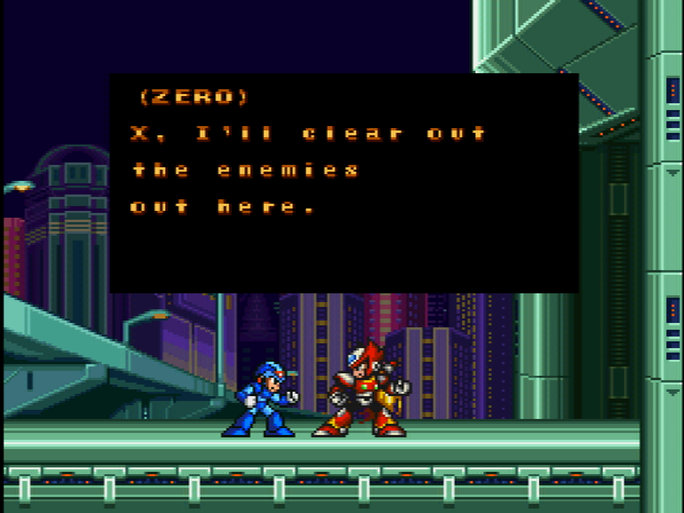
Guess who’s back? It ain’t Shady!
Mega Man X3 is probably the weakest link in the SNES series in terms of story telling. While the first game made waves by establishing X as a character (pushing the original Mega Man series into the future at the same time) and X2 was able to capitalize on Zero’s absence, X3 struggles to get off the ground. A lot of fuss is made over Dr. Doppler, an evil acolyte of Sigma, but anyone who has played any of the other MMX games is going to guess what is actually going on behind the scenes. Despite its mysterious trappings, the plot is essentially an encore of MMX where X and Zero are once again fighting alongside one another. An old villain from the first game is resurrected, so some of the events of MMX3 will feel like deja vu to fans of the series.
One may think all of these problems make for a bad story, but there’s a symmetry between MMX3 and the first two games that makes it a solid capstone to the series even though it’s predictable and retreads old ground. As a result, X3 has a sense of finality to it that makes it exciting. Today, we know it was far from being the end of the series, but at the time it felt as though that could have been the case.
FX Chip Goodness
MMX3 is the best looking of the Super Nintendo trilogy, though I will say it lacks some of the gorgeous details X2 flaunted. Even so, X3’s effects pushed the SNES to its limits with detailed animated backgrounds, flashy X-Buster effects, and wire-frame pseudo 3D enemies. Sadly, none of this is particularly novel or impressive until you compare it to other 16-Bit titles.
The redesigns of Zero and X stole the show as both characters were carefully animated and their weapons were vibrant with color as well as detailed transparencies. The Mavericks also had some impressive animations.
Speaking of Mavericks, the only thing I found disappointing about the graphics is the lack of special death and damage animations for the bosses. In X1 and X2, players were sometimes treated to special effects if they used the right weapon on a Maverick. For example, Chill Penguin would catch fire if you used a certain weapon on him. X2 even introduced special death animations for one or two bosses. This is something MMX3 could have run with but didn’t for whatever reason. In fact, special damage effects and death animations were dropped altogether, which is a real shame.
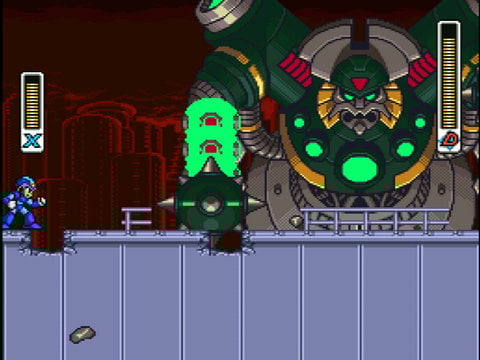
More depth and some missed opportunities.
Anyone who has played a Mega Man X game will recognize the formula immediately. Players are given a set of eight stages to conquer before challenging the final boss stages. As usual, these stages can be played in any order and X will obtain the weapon of every boss he sends to the junkyard. There are plenty of hidden power ups that range from increased health to a more powerful X-Buster in each stage. X3 saw the advent of “Chips”that could further enhance X’s abilities, but players are kind of limited to choosing just one.
Capcom also tried to expand on the concept of Ride Armor. In past games, Ride Armors were big mech suits that X would sometimes find laying around. These suits could punch enemies to pieces and absorb damage for X. They were a nice way to add variety to the game loop. Mega Man X3’s expanded Ride Armors gave players four different mechs to pilot, with each one having its own special capabilities.
This seems like a big improvement on paper, sadly, the Ride Armors didn’t really fit into X3 very well. To even use them, players had to first discover a specific Ride Armor hidden in a stage, then collect the other three, then find Ride Armor stations where X could actually equip them. The devs also tried to tie the new Ride Armors into the game by making them perquisites to acquire certain items, but this resulted in making what was once a fun feature of the game feel like a chore. At the same time, Ride Armor segments seemed shorter and less compelling despite being more common. In the end, this seems like it’s one of those game mechanics that the devs didn’t have time to implement properly and it ultimately hurt the overall experience.
Aside from the flawed Ride Armor system, X3 offers fairly strong gameplay. The stages and Mavericks aren’t as memorable as those from X1 and X2, but some of the things that made X2 annoying were fixed. There are also plenty of fun weapons to use. Plus the fact that Zero was finally a playable character helped this game along, even though there are restrictions on how much players can use him.
The bosses were not designed all that well, but that’s a common issue in MMX, so I can’t hold it against this one too much. That said, experienced players will learn how to catch many of the Mavericks in a loop fairly quickly. This may even be a good thing, because the early part of X3 feels more difficult than the first two titles.
Finally, MMX3 featured a few stages in the end game that would change depending on whether or not X defeated certain enemies. This may not sound like much, but the conditional bosses add a bit of depth to the game and make subsequent replays more interesting. At the same time, it’s easy to overlook these changes and they don’t add any shocking revelations to the story, so don’t get too excited about them.
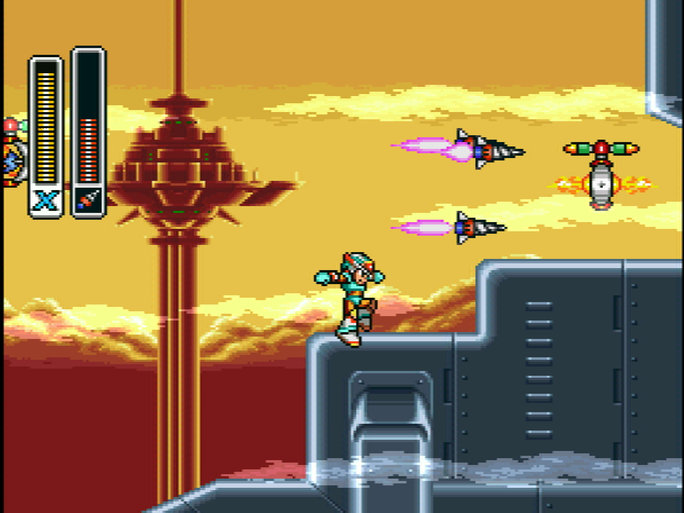
Everything was fine until I tried to do a vertical air dash.
Hmmm… the title for this section is kinda lame, but hopefully it gets the point about the controls across. MMX3 controls superbly, which should not be a surprise. It takes a lot of manual dexterity to perform certain moves, like dash jumping from a wall while charging the X-Buster, but the action starts to feel very fluid once you’ve learned the controls.
With that said, there is one mechanic that feels somewhat poorly implemented: The vertical air dash. If you’re wondering what an air dash is, let alone a vertical one, I’ll explain very briefly. X gained the ability to dash across the ground in a short burst of speed in the first game. The second game introduced the ability to dash left or right in the air. X3 takes it a step further by giving players the power to dash upwards. It’s a cool idea, but it’s also very finicky.
If you tap left or right on the D-Pad by accident while dashing vertically, the move will be canceled. This can lead to some bad situations as one might imagine. It also makes it difficult to execute the move by double tapping the D-Pad as you would with all the other dashes. Worse yet, the vertical air dash is slow compared to the other dash types. To be fair, I was able to vertical dash fairly reliably with a bit of practice even when using the D-Pad. It’s just a bit disappointing to see a series with such good controls struggle to implement new mechanics.
The Second Best Soundtrack in the Series
X3 has a great sound track. There aren’t any bangers, like “Our Blood Boils” from X7, but it’s still second to only X1 in terms of overall quality.
The sound effects are basically from the first two games, which is fine. After all, the sound of the X-Buster charging and X’s dash are pretty much iconic, so nothing needed changing.
Final Thoughts
Mega Man X3 may have its flaws, but they are not as annoying as those from many of the other titles in this series. Overall, I enjoyed it more than X2 but, less than X1. It gave the SNES series a good send-off and, looking back, I’m really happy that MMX got a trilogy at all in light of the fact that the SNES had a shorter life span than the NES.
Looking at the series through a wide lens, I feel like X2 and X3 relied a bit too much on flashy graphics rather than tight gameplay. Consequently, they were unable to match the mood and overall quality of the first game. That said, X3 is arguably one of the best games in the series and it’s a good choice for Mega Man veterans and newcomers alike.
Thanks reading my Mega Man X3 review!
RetroMaggedon.com ©2026