
Final Fantasy III (Super Nintendo) Review
Chung chung… Chung chung… Magitek Armor!!!!
~tankMage (March 2026)
Score: 94/100 (Excellent)
Final Fantasy III (do I need to state that it’s actually Final Fantasy VI?) is one of my favorite JRPGs, so expect a very biased review. It’s also fair to say that this is one of those games that gets so hyped up by fans that it can’t possibly live up to expectations. If you go into this game beliving all the hype, you’ll be disappointed. On the other hand, open minded players who go in without sky high expectations will likely be able to appreciate FF3 for what it is: A classic 16-Bit RPG that told one of the best stories the series has to offer.
The Evil Empire strikes again!
FF3 has one of the most skilfully crafted and presented stories of the 2D era. It starts with a brief cutscene that ominously describes the ancient War of the Magi, which was fought using magic as the name suggests, then goes on to explain that an evil Empire has rediscovered magic and is using it to dominate the world. Players are soon introduced to a mysterious young woman who is under the control of two imperial soldiers. Together they attack the town of Narshe where a mysterious being known as an Esper was found. Players get to control the magical weapons of the Empire first hand in the beginning and see the ruthlessness of the antagonists as they attack Narshe. Things get complicated when they finally reach the Esper and the young woman reacts to it.
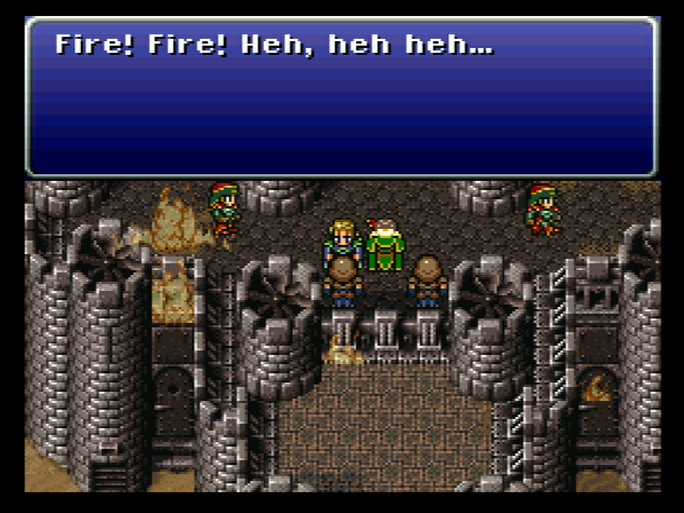
Much of the game focuses on the war between the Empire and what remains of the free world while it introduces a large cast of playable characters who have their own back stories. As usual, I’ll avoid spoiling things, so I’ll just say the story takes a lot of twists and turns.
One of FF3’s greatest strengths is that it does not go to great lengths to explain itself. The backgrounds and motivations of many characters are often left somewhat obscure or merely hinted to through random scraps of conversation or dream sequences. There are even instances where the ultimate fate of some characters is left open ended.
While some players may not like the fact that FF3 keeps its secrets tightly locked away, I feel that this is one of its greatest strengths. The script often alludes to the burden of the heroes or illustrates it just enough to give the player’s imagination something to work with rather than beating them over the head with long monologues. It’s easy to dismiss Final Fantasy III’s vagaries as plot holes or bad writing, but doing so fails to take into account the scope of the tragedy that befalls the world. After all, the personal suffering of the cast are easily eclipsed by the cataclysmic events of the war. At the same time, FF3 often manages to make its story very personal and poignant, which was not an easy feat.
If there is one aspect of the story that deserves criticism, it’s the translation, which is plagued by all of the usual ills that translations from this era suffer. Certain lines were censored or interpreted very awkwardly. Plus, some scenes seemed like they were missing big chunks of script when I played this after the GBA port, which had a very good translation.
As much as I dislike this treatment of the script, I have to admit there are times when it really shines thanks to its less literal interpretation. Additionally, anyone who wants to know what it was really like to play FF3 in the 90s will appreciate this version of the script, so it’s not without merit.
Classic JRPG Gameplay with a Bit of Innovation
Final Fantasy III does not stray far from its forebears, but it does feature a few subtle innovations. Players will fight in turn based and often random battles like in most other JRPGs from this time. Towns, dungeons, and the usual overworld map all await exploration. Careful players will discover a slew of hidden items and even secret characters. While all of these things add flavor to the game, it’s creative character and dungeon design that make FF3 what it is.
Most of the dungeons are more than just mazes with a boss at the end, they often have gimmicks that make them feel unique. For example, one dungeon requires the player to form two parties that have to cooperate to open the way forward. Another dungeon forces the player to use only magic to defeat enemies. The list goes on and I do not want to spoil anything for new players, so hopefully these few examples suffice.
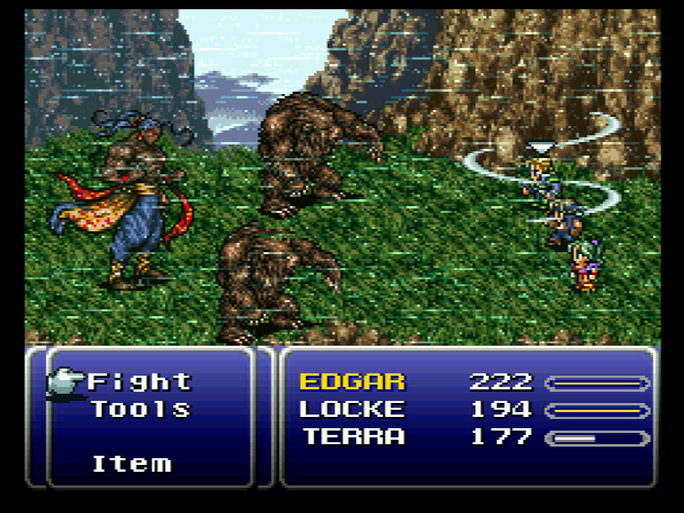
Every character has a specialty that makes him or her unique. This isn’t anything new to RPGs, but the creators of Final Fantasy III put extra effort into the heroes. One guy can execute special attacks by entering button combos like in a fighting game. Another can use her sword to intercept spells. There is even a character who can imitate the behavior of monsters, which may not seem impressive until you realize he can learn the abilities of over 200 enemies. I could spend paragraphs talking about the heroes and their special abilities, but I’ll stop here to keep it brief.
While the heroes were generally fun to use, some of them had fairly useless abilities or, worse yet, bugged skills that could break the game. Cyan, a master of the sword, has one the coolest skill sets of all the heroes. Selecting his Sword Tech skill and waiting for the bar to fill up allows him unleash powerful attacks. Unfortunately, everyone in the party has to hold his or her turn while Cyan’s bar fills up, which makes the skill kind of useless unless you are using one of the low level Sword Techs. Another character, Relm, uses a skill that’s so badly bugged it can crash the game, though it’s only fair to point out that there is an item not only upgrades her skill, but also fixes the bug inadvertantly.
Characters are also more customizable than those of most previous Final Fantasy titles, though FF5 still leaves this game in the dust as far as customization goes. Players will eventually find an item called Magicite that can teach nearly anyone magic. The type of Magicite determines the type of spells a character will learn and Magicite is equipped like a weapon or armor. What makes Magicite interesting is that some types of Magicite give its holder a permanent stat boost when they gain an experience level. This allows players to emphasize a hero’s strengths or cover their weaknesses, which is a nice feature. However, swapping Magicite between characters so they get level up bonuses can get tedious.
Nobuo Uematsu’s Finest Hour
There are few soundtracks that are effective at conveying emotion as this one. From the very start, the intro theme establishes a sense of foreboding and the rest sound track takes off from there. Every character has a theme song that reflects their personality almost perfectly. The overworld themes (yes there’s more than one) do a great job of setting the tone of the game in general and the dungeon songs imbue the game with a sense of mystery.
That’s not to say every song in FF3 is perfect. I’ve always felt the opera scene tried to do more than what was technically feasible at the time and the main battle theme gets old after the first twenty hours. But even the weaker tracks are still very good.
I know my opinion of this soundtrack puts me at odds with many other fans and even the composer himself, who has gone on record saying he preferred Final Fantasy VII’s soundtrack. To be fair, I would put FF7 in second place; it’s that good. However, a lot of the music from FF7 feels like rehashes of older songs that Nobuo took the time to reinvent using more advanced equipment and CD quality fidelity. Consequently, FF3’s soundtrack feels more spontaneous and original even if it may not be as technically advanced.
Graphics
I’ve always thought Final Fantasy III was a dingy looking game, especially by the standards of the SNES. A lot of the environments are drab grays and browns, making the game world feel bleak. This may sound like a bad thing, but it fits the setting. After all, the heroes live in a world undergoing an industrial revolution and a catastrophic war at the same time. Whether it’s the icy streets of Narshe or the wide open Veldt, there always seems to be a shadow looming over the scene and the visuals grow increasingly somber as the story progresses. For the most part, the choice of color was really inspired, but it sometimes made the game feel lackluster compared to other Super Nintendo titles.
The contrast between the player’s party and the enemy in combat is another clever visual technique. In the 2D FF games, player’s party often has an anime style design while the monsters often look like very detailed color sketches. This effect was taken to extremes in FF3, with enemies often having surreal qualities. Players even get to see a few examples of this effect applied to party members early on when they fight enemies riding Magitek Armor. When the party has Magitek Armor it looks almost cartoonish and harmless, while Magitek Armor enemies look like sleep paralysis demons despite the fact that they are in the same faction using the same machines. I love how Square took this style of character design to its logical conclusion in the series’ final 2D title. Players even get to see this rule applied to certain major enemies who will go unnamed.
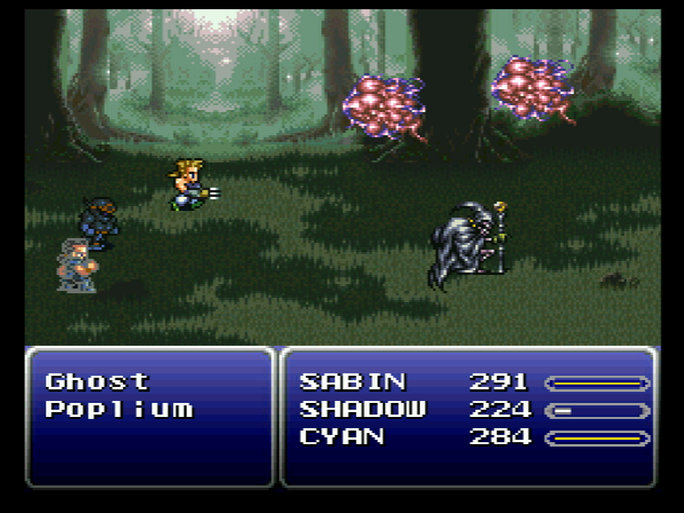
The environments are also very detailed and sometimes have nice layering effects. That said, a lot of tiles were recycled. Players can expect to visit a fair amount of mountains and caves that all look more or less alike, which is pretty normal even by modern standards. There are also a few places that are totally unique, which justify some of the corner cutting since it saved on space.
Effects like summons, magic spells, special skills, and Mode 7 sequences achieved mixed results. Some skills and spells look really nice, while others were very bland or were recycled versions of other effects. Summons were highly detailed and used the same hyper-real art style of enemies, but they were not animated, though this seemed to be a convention of the 2D FF games. The Mode 7 sequences often look clumsy and sometimes feel like they were shoehorned into the game, because the devs didn’t seem to be able to figure out any other way of depicting certain sequences.
A UI only Kefka could love.
If there is one thing I do not like about Final Fantasy III, it’s the UI. That’s not to say this game has a bad user interface, especially when compared to other RPGs on the Super Nintendo, it just isn’t well suited to the management of so many characters. For example, players need to give four party members equipment before setting out on adventures. While the game allows you to simply auto-equip everyone or leave gear on their characters, the large size of the cast and limited nature of resources often force the player to juggle equipment frequently. The “Optimize” gear command also tends to equip items that aren’t all that good, just because they have high attack or defense values.
On top of that, players who want to have powerful heroes will have to equip Espers that grant bonuses on level up. Unfortunately, many Espers lack level up bonuses or offer undesirable ones, so the player has to constantly shuffle Espers around. Players also need to make sure nearly every one of their characters are leveled up, because just about every playable character has to fight in the last dungeon, so they will inevitably find themselves banging their head against the UI at some point even if they go with the easiest gear setups possible.
FF3 also lacks an autobattle function, which is pretty rough for a game with so many characters to train. Some players may dislike the party swapping system, which requires the player to go to specific locations and talk to idle party members, but I actually kind of like the system; it makes changing party members out feel more natural.
While I griped about the UI a lot, I will say it works well enough and I’ve seen far worse. I also have to say I’m very grateful this game uses a shared inventory pool that every character can draw items from, because it would be a nightmare if it used Dragon Quest style personal inventories. Finally, the player can customize the UI in a lot of ways, which is very nice for a 16-Bit RPG. So yeah, it’s not a terrible UI.
Final Thoughts
Final Fantasy III brings a lot to the table, but like any game, it needs to be approached with an open mind. As I said at the start of this review, the legendary status of this and other 16-Bit RPGs is impossible to live up to. At the same time, FF3 really is special. There’s plenty to see and do, yet the flow of the game feels purposeful and focused. The story hits hard, but also leaves a lot to the player’s imagination. And don’t forget the music, which is possibly the best in the series. Most RPG fans will enjoy this game as long as they allow it to take the lead.
Thanks for reading this review for Final Fantasy III on the Super Nintendo!
RetroMaggedon.com ©2026