
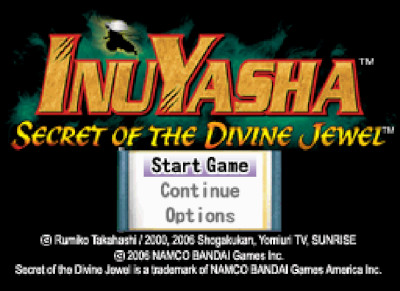
Inuyasha: Secret of the Divine Jewel (Nintendo DS) Review
Great story, too bad they forgot about the game part.
~by tankMage (June 2026)
Score: 70/100 (Decent)
Inuyasha: Secret of the Divine Jewel is another Nintendo DS game everyone seems to hate. I didn’t know that its aggregated score is currently sitting somewhere around 43 out of 100 when I started playing and didn’t think it was THAT bad. However, Inuyasha was a big deal back in the 2000s, so its reasonable to assume fans of the the series had high expectations for licensed games, especially when you take into account the close relationship between anime and JRPGs. I suspect a lot of players were let down when they realized Secret of the Divine Jewel was very flawed.
Personally, I found this title to be a slog, but bearable. Clues regarding where to go and what to do are often vague or straight up nonexistent. Random battles are painfully frequent. And there is very little in the way of character development and customization. Players can’t even equip party members with weapons or armor, which leaves the game feeling very flat.
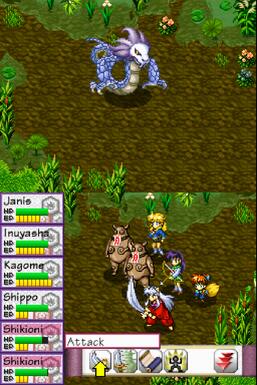
As I said, I was unaware of the game’s poor reception and went in with modest expectations. Having played and reviewed quite a few DS games over the years I know just how bad things can get, so the fact that Inuyasha is a rather poor game in the grand scheme of things is outweighed by the fact that the Nintendo DS is home to some truly horrid shovelware. At the same time, I actually enjoyed the story, which took a few unexpected twists and turns. I also felt like the game had great music and atmosphere, plus the gameplay has its own charm even if it is often tedious.
Hey, uh, you got any more of them Shikon jewels?
The story centers around an American exchange student named Janis who befriends Kagome in school. One day, Inuyasha gets Kagome to return to the feudal era to help him out and Janis follows her to the Bone Eater’s well, which transports her to Inuyasha’s Forest. Janis soon learns of Kagome’s secret life and accompanies her on a series of adventures. Janis soon learns that she has a mysterious power when a Shikon Jewel binds with her. Consequently, Inuyasha and his friends set out to help her solve the mystery surrounding her powers and recover the Shikon Jewel.
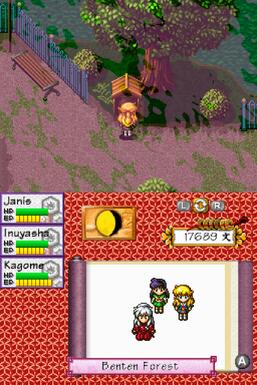
As far as I can tell, the plot sticks very closely to the premise of the anime (to be honest, I’ve only seen about ten episodes) without rehashing events. I have to give the devs a lot of credit here, because anime based games (which should be one of the easiest things to convert into a game) often fail to hit the mark when it comes to story telling. Somehow, this title manages to give players a new adventure that’s entertaining enough to feel like it could be a story arc from the anime without stepping all over the lore. It’s also one of this game’s few strengths.
It’s the Nintendo DS, what did you expect?
They tried really hard to emulate Inuyasha’s art style and did a good job, but the Nintendo DS’s awful resolution makes everything look choppy and jagged. 256p isn’t really enough to work with if you’re going for anime style graphics, so I can’t fault the devs. Even the usual tricks used to get more out of the tiny screen (like putting status windows and stuff on the second screen) didn’t really help the graphics.
It’s a real shame, because there were plenty of creative demons along with the anime’s imaginative cast which would have looked great on another system. Its clear the devs really tried to make this game look good, but it didn’t work out. Even with its shortcomings, Secret of the Divine Jewel still has its charm and manages to capture the anime’s atmosphere, so it’s not a total failure.
No touchscreen shenanigans here!
If there is one thing I hate about the DS, it’s the profusion of games with awful touchscreen mechanics that were made for it. Secret of the Divine Jewel is an example of touchscreen interface done right. It didn’t need mini-games or puzzles that involve the touchscreen and the devs wisely left them out. Players who want to use the touch interface can use it to move the party, give commands, and navigate menus. Players who do not want to use the touchscreen can use the buttons to do all of the same things. Consequently, this is one of the best user interfaces I’ve encountered on the DS.
Inuyasha certainly didn’t have it this easy in the anime…
Secret of the Divine Jewel is a really basic RPG at heart. Players wander around exploring feudal Japan and fighting monsters in simple turn based battles. There are a few towns and shops to visit, but they’re very small. Most of the dungeons are also tiny and easy to navigate.
Things like equipment and character builds do not exist in this title aside from amulets players can have made. Amulets aren’t even important, because I managed to go through three quarters of the game without them and did just fine. Their effects are very basic things like increased defense or resistances.
Combat does not offer veteran RPG fans any challenge. Most monsters, even bosses, are blown away with a few attacks and it’s easy to steamroll the first three quarters of the game without leveling up much. There are a few bigger dungeons that come with a difficulty spike near the end, but they are only mildly challenging and a bit of grinding takes the edge off of them.
Secret of the Divine Jewel’s simplicity somehow works in its favor. While I did not feel challenged by this title, I did get some enjoyment from it. It was nice to play an RPG that was just focused on the basics. Maybe adding more complexity would have improved the experience, but it may not have had the same charm that makes it kind of enjoyable.
Uhhhh where do I go?
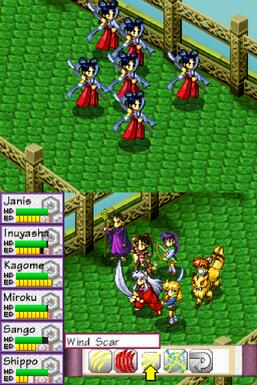
Yup, Inuyasha is one of THOSE games. You know how it is: Everything is going great, then you can’t figure where the game actually wants you to go and what it wants you to do. In this case, there were a few points where I had no idea what I was supposed to do and there were no hints from NPCs or the cast. In most cases, I was able to figure things out by wandering around and exploring, but I had to look up where to go in other cases.
While I appreciate games that encourage players to use their brains, Secret of the Divine Jewel went a bit too far at times. I spent hours looking around for the next progression point and couldn’t figure out where to go several times. Worse yet, what I needed was in a remote location near the start of the game in both instances. I’m not sure how they expected players to figure out where to go, because it would have taken me forever to do so without a guide. I can imagine how frustrating it may have been to play this in 2007 without help.
A random battle with every step!
If you’ve played older JRPGs, you’re probably familiar with the random battles that occur in dungeons and on the world map. Random battles often had really high rates in 8 and 16-Bit RPGs. By the time Secret of the Divine Jewel came out they had largely fallen out of vogue and games that did feature random encounters often toned their odds down. The devs apparently didn’t get the memo, because this game has one of the highest encounter rates I’ve seen. It’s probably on par with the original Final Fantasy, which sometimes had battles every few steps.
Enemies will CONSTANTLY jump you in dungeons. I often completed one battle only to find myself in another right away. Usually, you can just just run from fights, but doing so is risky and unpleasant in Inuyasha. Every character has to escape on his own, which makes the process of fleeing unwanted fights really slow.
To throw salt in the wound, some enemies can paralyze your party members. Paralysis is permanent, so a character is basically dead if they are alone when it happens. Guess what happens if your paralyzed guy dies after everyone else escapes? That’s right, GAME OVER! The only times I lost were when I tried to run and an enemy managed to paralyze my last character. That may not sound bad, but paralysis becomes incredibly common near the end of the game, which made the escape option worthless. You just had to fight out every stinkin’ battle. Even early JRPGs didn’t pull that crap.
The only saving grace is an amulet that decreases the encounter rate a bit. It’s not much, but it helps and I recommend getting one as soon as possible.
One final point about the high random battle rate is that it likely contributed to the game being too easy. You’re gonna be so over-leveled from fighting a zillion enemies throughout the game that even bosses are a joke, which is kind of ironic.
At least the music is nice.
I really enjoyed the music and sound effects used for Secret of the Divine Jewel. A lot of it was inspired by the sound track from the anime, which makes sense. The battle music was particularly good. All of the songs used traditional Japanese instruments, which gave the game a unique feel.
Instrumental tones were employed for the menu sound effects, which was a really nice touch. I was a bit surprised at the lack of voice acting, but I think it worked in the game’s favor. Hearing characters shout constantly gets annoying after a while, so I’m fine with this game not using voice clips.
Final Thoughts
Inuyasha: Secret of the Divine Jewel doesn’t take risks nor does it attempt to innovate. In fact, it lacks things some of the oldest RPGs have, like equipment and character growth. It also commits some of the worst sins that RPGs made decades before it were guilty of as though the devs had learned nothing from the past. It’s no surprise people hated this game when it came out.
At the same time, I liked its story and old-school atmosphere. The gameplay is also salvageable if you are patient and don’t expect much. That said, an RPG based on Inuyasha should be an easy win. Too bad the devs choked. I took some time to look up Art Co (who made this game) and the titles accredited to them seem really lackluster. If anything, Secret of the Divine Jewel is one of their finer moments, which is sad seeing as how this game struggles to achieve mere mediocrity.
Recommendations
JRPGs were starting to ride off into the sunset by the time this game hit shelves (Yeah, I know they are still being made to this day) so it’s kind of special for just being a basic Role Playing Game. The story should also satisfy fans of Inuyasha. Unfortunately, I don’t really see much of a reason to play this game unless you really love wandering around, not knowing where to go. I can also see the random battles really annoying most modern audiences, so it’s safe to skip this game, I sure wish I did.
Thanks reading my Inuyasha: Secret of the Divine Jewel review!
RetroMaggedon.com ©2026